

If you’ve ever had to deal with a VPN either as a user or managing one you’ll know they’re not exactly loved.
They’ve been the standard for years, and to be fair, they’ve done the job. But the way people work now has completely changed, and VPNs just haven’t kept up.
We see it all the time. Slow connections, especially when someone is travelling. Users forgetting to connect. And from an IT side, a lot more time spent managing and troubleshooting than there should be.
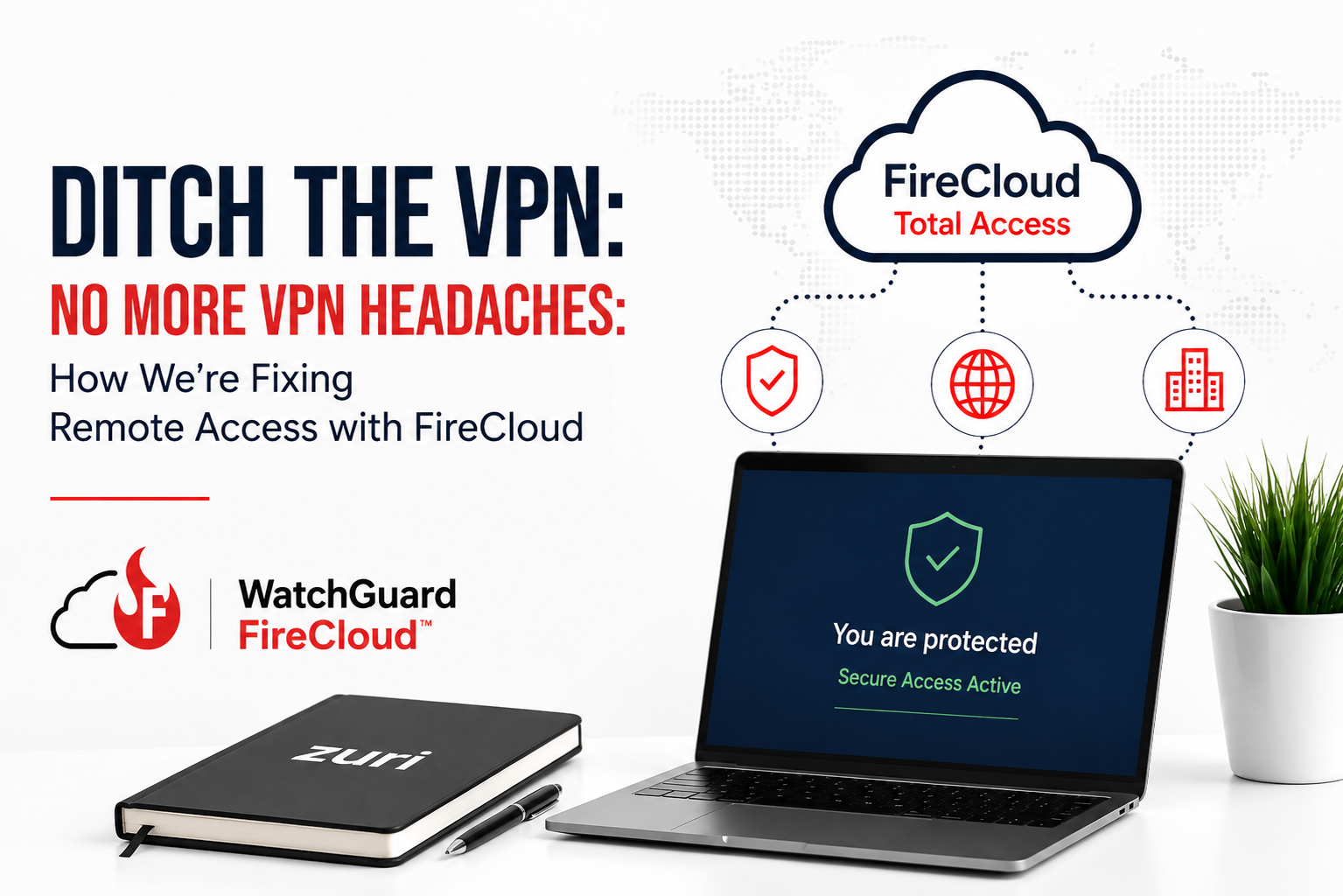
Recently, we’ve started moving clients away from traditional VPN setups and onto something much more modern: WatchGuard FireCloud Total Access.
And honestly, it’s been one of the smoother transitions we’ve done.
VPNs were built for a different kind of working environment mainly office-based, with the odd bit of remote access.
Now, people are working from everywhere. Home, hotels, shared spaces, different countries you name it.
The problem is, a VPN still tries to route everything back through one central point, usually your office firewall. That’s where the performance issues start. If someone’s abroad, that connection can feel painfully slow.
On top of that, it relies on the user doing the right thing connecting when they should. If they don’t, they’re outside your security controls.
From our side, they’re also not the easiest things to manage as setups grow. Visibility isn’t great, and control tends to be quite broad rather than specific.
This is where FireCloud comes in.
Instead of dragging the user back into the network, it flips things around and delivers secure access to wherever the user actually is.
We’ve set up several FireCloud Total Access environments now, and the best way to describe it is simple—it just works.
Users connect automatically to the nearest secure distribution point, so they’re not bouncing traffic halfway across the world just to get into the office network. That alone makes a huge difference to performance.
We’ve had people travelling who didn’t even realise anything had changed other than things being faster.
One of the biggest improvements, in my opinion, is that security is always on.
With a VPN, protection depends on whether the user is connected. If they forget, disconnect, or just don’t bother, they’re effectively outside your network.
With FireCloud, it doesn’t matter where they are or what network they’re on. The protection is still there.
Home Wi-Fi, café, airport it’s all treated the same.
That removes a massive risk and takes the pressure off users having to “do the right thing” all the time.
From the user’s point of view, nothing really changes in terms of what they can access.
They still get to:
Everything they’d normally use a VPN for is still there.
The difference is they’re not fighting with it anymore.
The big shift is how access is handled.
A VPN basically says: “You’re connected, so you’re trusted.” That’s a pretty broad approach.
FireCloud is much more controlled. Access is based on who the user is, the device they’re using, and the policies you’ve set.
There’s no single choke point, no need to backhaul traffic through one location, and you’re not exposing your entire network just because someone connected.
In simple terms, instead of extending your network outwards, you’re delivering secure access in a much more controlled way.
Since rolling this out, a few things have stood out straight away.
Performance complaints have pretty much disappeared, especially from users working abroad. Support tickets have dropped, and from an IT perspective, it’s just easier to manage.
But the biggest thing is consistency. Security is always there, and access works the way people expect it to.
VPNs aren’t going anywhere overnight, but they’re definitely starting to show their age.
FireCloud Total Access feels like a solution that’s built for how people actually work now.
From what we’ve seen, it’s easier to manage, better for users, and far more secure by default.
If you’re still relying heavily on VPNs, it’s definitely worth looking at what the alternatives can offer.